
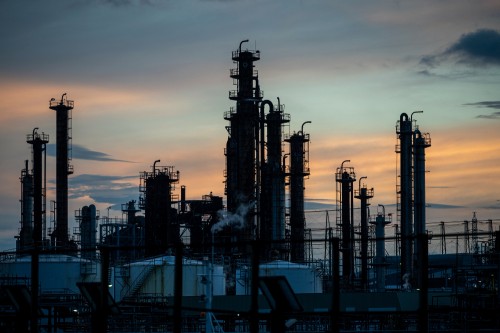
Oil prices surged on Monday amid escalating tensions in the Middle East, stirring concerns over inflation and prompting speculation that central banks might need to raise interest rates. Brent crude, a key global oil benchmark, climbed as high as 1.77% to $111.16 per barrel, marking its highest point in nearly two weeks, following an assault on a nuclear facility in the United Arab Emirates. The price later settled at $110 per barrel after Iran indicated it had responded to a new U.S. initiative aimed at resolving the conflict.
The rise in crude prices coincided with stalled peace negotiations between the United States and Iran, now in their sixth week of ceasefire. Former President Donald Trump intensified the situation by warning Iran in a social media post, stating, “For Iran, the Clock is Ticking, and they better get moving, FAST, or there won’t be anything left of them. TIME IS OF THE ESSENCE!” Meanwhile, Iran’s foreign ministry spokesperson, Esmaeil Baqaei, mentioned ongoing discussions facilitated by Pakistan, although specific details were not disclosed.
Amid these geopolitical tensions, global bond markets experienced volatility. The 10-year U.S. Treasury yield reached 4.631%, its peak since February 2025, before retreating slightly to 4.599%. In the UK, the 10-year gilt yield rose to as high as 5.19%, surpassing an 18-year high hit on Friday, before settling at 5.15%. This instability in UK government bonds is further fueled by political uncertainty, with speculation that Prime Minister Keir Starmer might face a leadership challenge from Manchester Mayor Andy Burnham.
As UK Chancellor Rachel Reeves and G7 finance ministers convened in Paris to discuss the economic ramifications of the Middle East conflict, economists like Mohit Kumar of Jefferies expressed concern over a potential “shift to the left” in UK politics. He noted that the UK fiscal situation is already strained, with limited capacity for increased public spending, while current tax levels may not yield additional revenue if raised. Kathleen Brooks of XTB suggested that UK bond yields could recover if markets perceive Burnham as moving away from high-spending policies.
Japan also saw bond yields rise, with the 10-year yield nearing a 30-year high at 2.8% as the government prepared to issue new debt to mitigate the economic impact of the Middle East unrest. European stock markets opened lower, with the Stoxx Europe 600 index dropping 0.7% and the UK’s FTSE 100 remaining stable. In Asia, Japan’s Nikkei and Hong Kong’s Hang Seng index both fell by about 1%, while China’s SSE Composite dipped 0.1%. South Korea’s Kospi, however, closed 0.3% higher, reflecting the mixed responses in global markets.