
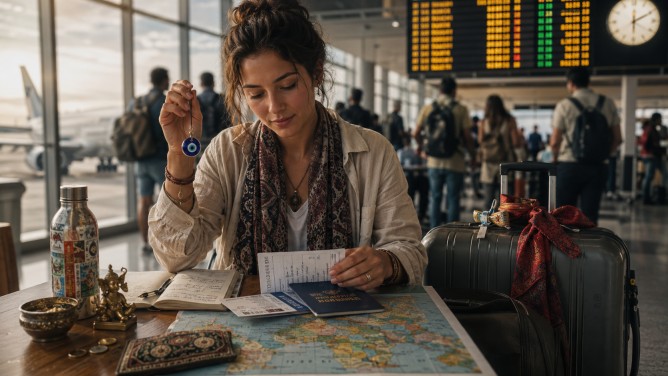
Traveling often comes with its own set of unique customs and rituals that aim to ensure a safe and auspicious journey. Across various cultures, travelers adhere to a range of intriguing superstitions to attract good fortune and ward off bad luck while on the move. These beliefs, though lacking scientific backing, hold significant cultural value and add a layer of excitement to the journey.
One such tradition involves the use of garlic in parts of the Balkans, where carrying a clove of garlic in one’s luggage is thought to protect against negative energy and the evil eye. Similarly, the act of touching the exterior of an aircraft before boarding is a common practice among some travelers, who believe it brings good luck and offers comfort to those nervous about flying. Another widely followed superstition involves stepping onto a plane with the right foot first, which is believed to set a positive tone for the trip.
In regions of the Middle East and the Balkans, it’s customary for families to pour or sprinkle water behind someone embarking on a journey. This act symbolizes a smooth passage and the hope of a safe return. Additionally, the avoidance of certain numbers is a notable practice in various cultures. For instance, while the number 13 is commonly deemed unlucky in Western countries, the number 4 is avoided in China due to its phonetic resemblance to the word for death, and in Italy, 17 is traditionally seen as unlucky. These beliefs sometimes influence choices related to hotel room numbers and building floors during travel.
Other travel-related superstitions include the practice of sitting on packed luggage briefly before setting off, a tradition among Slavic peoples that provides a moment for reflection and mental preparation. Additionally, in several cultures, sweeping the floor immediately after a traveler departs is avoided, as it’s believed that doing so could symbolically sweep away the person’s good fortune or hinder their safe return. These customs persist not because of their efficacy but because they serve as a means of preserving cultural identity and familial traditions, enriching the experience of setting off on a new adventure.